Page 1 of 1
@Martin Vicanek LP & HP
Posted: Mon Oct 15, 2018 2:27 pm
by wlangfor@uoguelph.ca
I have been very happy with Your one pole HP and LP filters Martin,
And wondered; If I was to use the same code for a crossover; Is it possible for You combine the code of both the HP and LP
so that it uses less resources?
I have a 20 band one working now and yet it only uses 1.4 cpu. I wanted to ask You if it is possible because it would save CPU.
I wanted to name it Vicanek crossover eq; is that OK?
Basically it is an equalizer for people trying to avoid the math of a co-efficient equalizer. The results are pleasingly jagged and yet
the transients are also tilted. Sometimes I find linear amplitude added is more ideal.
Please let Me know; I think Your LP and HP are the best I've tried.
I recently used them in a new product I'm working on called the TQ:
TQ EQ (Thanks to Loopeytunes for Knobs):
The attachment tq resized.jpg is no longer available
Imperium 778 (20 Band Vicanek Crossover) Thanks to Loopeytunes and Nubeat for GUI Elements
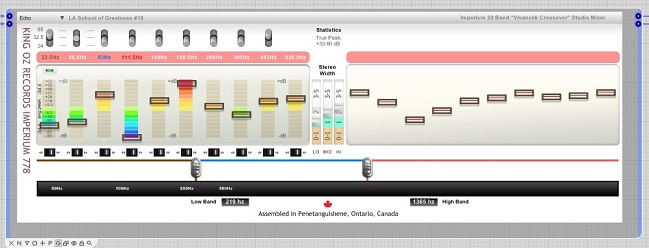
- Vivancek Crossover EQ
- 82877_PT2__AC_SL1500_V1489184956_.jpg (54.29 KiB) Viewed 26254 times
Imperium 777 Processor Thanks to Loopeytunes and Nubeat for GUI Elements:
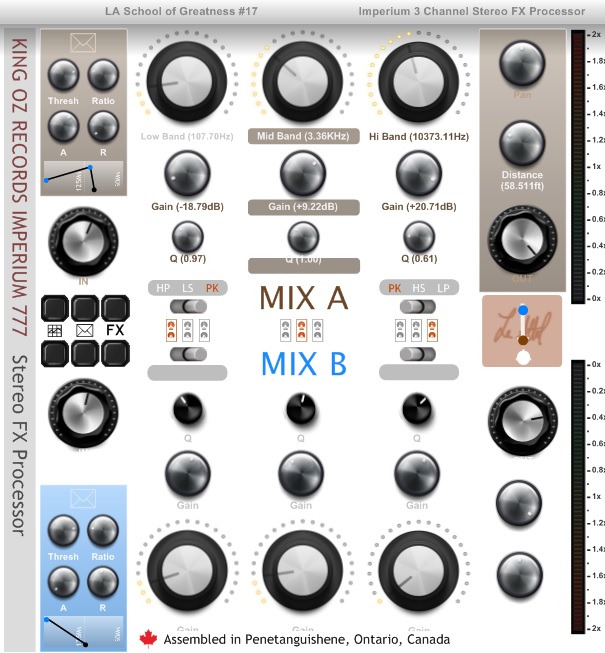
- imperium processor
- imperium 777.jpg (122.85 KiB) Viewed 26259 times
Re: @Martin Vivancek LP & HP
Posted: Mon Oct 15, 2018 7:37 pm
by martinvicanek
wlangfor@uoguelph.ca wrote:Is it possible for You combine the code of both the HP and LP
so that it uses less resources?
Yes:
I wanted to name it vivancek crossover eq; is that OK?
Well, these things had been there long before I appeared on the scene so I didn't invent any of it. Anyway, if you want to use my name please spell it correctly.

Re: @Martin Vivancek LP & HP
Posted: Mon Oct 15, 2018 7:43 pm
by wlangfor@uoguelph.ca
martinvicanek wrote:wlangfor@uoguelph.ca wrote:Is it possible for You combine the code of both the HP and LP
so that it uses less resources?
Yes:
AllInOne_LP_HP.fsm
I wanted to name it vivancek crossover eq; is that OK?
Well, these things had been there long before I appeared on the scene so I didn't invent any of it. Anyway, if you want to use my name please spell it correctly.
Thanks Martin, I will not make that mistake again and I will spell Your name correctly from here on in.
Re: @Martin Vicanek LP & HP
Posted: Tue Oct 16, 2018 2:13 pm
by wlangfor@uoguelph.ca
Hi Martin, I have a question;
Normally; The example schematic You gave Me is ideal but to reach that small CPU load I am loading everything in parallel, Would it be possible for a version with two frequency inputs; One for HP "and" LP?
The savings on extra work is also great.
is just paste together pieces like so:
parent -------[0 - 62hz]
-------|-------[63hz - 100hz]
-------|-------[101-Max]
And it works very well. Can You also make sure to provide the DSP code please? DSP code "most times" sounds nicer than optimized Assembled modules.
Re: @Martin Vicanek LP & HP
Posted: Tue Oct 16, 2018 10:15 pm
by martinvicanek
wlangfor@uoguelph.ca wrote:Would it be possible for a version with two frequency inputs; One for HP "and" LP?
Well, then we're back at individual HP and LP modules, no?
Can You also make sure to provide the DSP code please?
You have the green text boxes with the equations, it should be straight forward to translate that into code.
DSP code "most times" sounds nicer than optimized Assembled modules.
Interesting. I would have thought they sound exactly the same, given that the outputs are bitwise identical.
Re: @Martin Vicanek LP & HP
Posted: Wed Oct 17, 2018 2:01 pm
by wlangfor@uoguelph.ca
martinvicanek wrote:wlangfor@uoguelph.ca wrote:Would it be possible for a version with two frequency inputs; One for HP "and" LP?
Well, then we're back at individual HP and LP modules, no?
Yes, but I was curious if there were a way to put them together. I notice they use a method called stage 1 and stage 2 that I have not figured out how to use yet.
martinvicanek wrote:wlangfor@uoguelph.ca wrote:Can You also make sure to provide the DSP code please?
You have the green text boxes with the equations, it should be straight forward to translate that into code.
Text boxes and equations? Hmm, I didn't know that could be done, I'd only ever changed DSP code into Assembled and not vice versa; I'll figure out how to do that.
martinvicanek wrote:wlangfor@uoguelph.ca wrote:DSP code "most times" sounds nicer than optimized Assembled modules.
Interesting. I would have thought they sound exactly the same, given that the outputs are bitwise identical.
I would have thought so too; The difference is negligible most times; But in the case of treble I can hear dimension and grit; Where in the case of Bass I suppose there might be complexity. I only notice the difference when mixing treble (2kHz - 7kHz).
I've been mixing music everyday for the last 6 years so My ears have become very sensitive.
Anyways, thanks Martin.
BTW; I've noticed that running things in parallel causes less headaches with the following:
I had wondered why the pro companies like Solid State Logic were using parallel; But then, I was able to use Your HP's and LP's to make a naïve filter that has only -0.0015 dB variance.
Constantly forcing the effects of the last filters onto a new one causes degrade and as we both know to stay at unity You can only take away and not gain. I noticed there was a large difference in bass; I tested for unity with each band and was very pleased with the result.
Frankly, I believe Your HP and LP is the best available; And that's after using many.
But I respect that You're a busy person, and I do not want to take up too much of Your time, thanks again.
- Robert
Re: @Martin Vicanek LP & HP
Posted: Thu Oct 18, 2018 2:13 am
by martinvicanek
wlangfor@uoguelph.ca wrote: a method called stage 1 and stage 2 that I have not figured out how to use yet.
It is explained in the User Guide
Text boxes and equations? Hmm, I didn't know that could be done
I often use text boxes for documentation. The equations I was referring to are those of a one pole HP or LP
Transposed Direct Form II
--------------------------
out = s + b*in
s = b*in - a*out
where s denotes the filter state and a and b are filter coefficients.
Re: @Martin Vicanek LP & HP
Posted: Thu Oct 18, 2018 1:42 pm
by wlangfor@uoguelph.ca
martinvicanek wrote:wlangfor@uoguelph.ca wrote: a method called stage 1 and stage 2 that I have not figured out how to use yet.
It is explained in the User Guide
Text boxes and equations? Hmm, I didn't know that could be done
I often use text boxes for documentation. The equations I was referring to are those of a one pole HP or LP
Transposed Direct Form II
--------------------------
out = s + b*in
s = b*in - a*out
where s denotes the filter state and a and b are filter coefficients.
Very good, thanks

.